
 Image 1 of 1
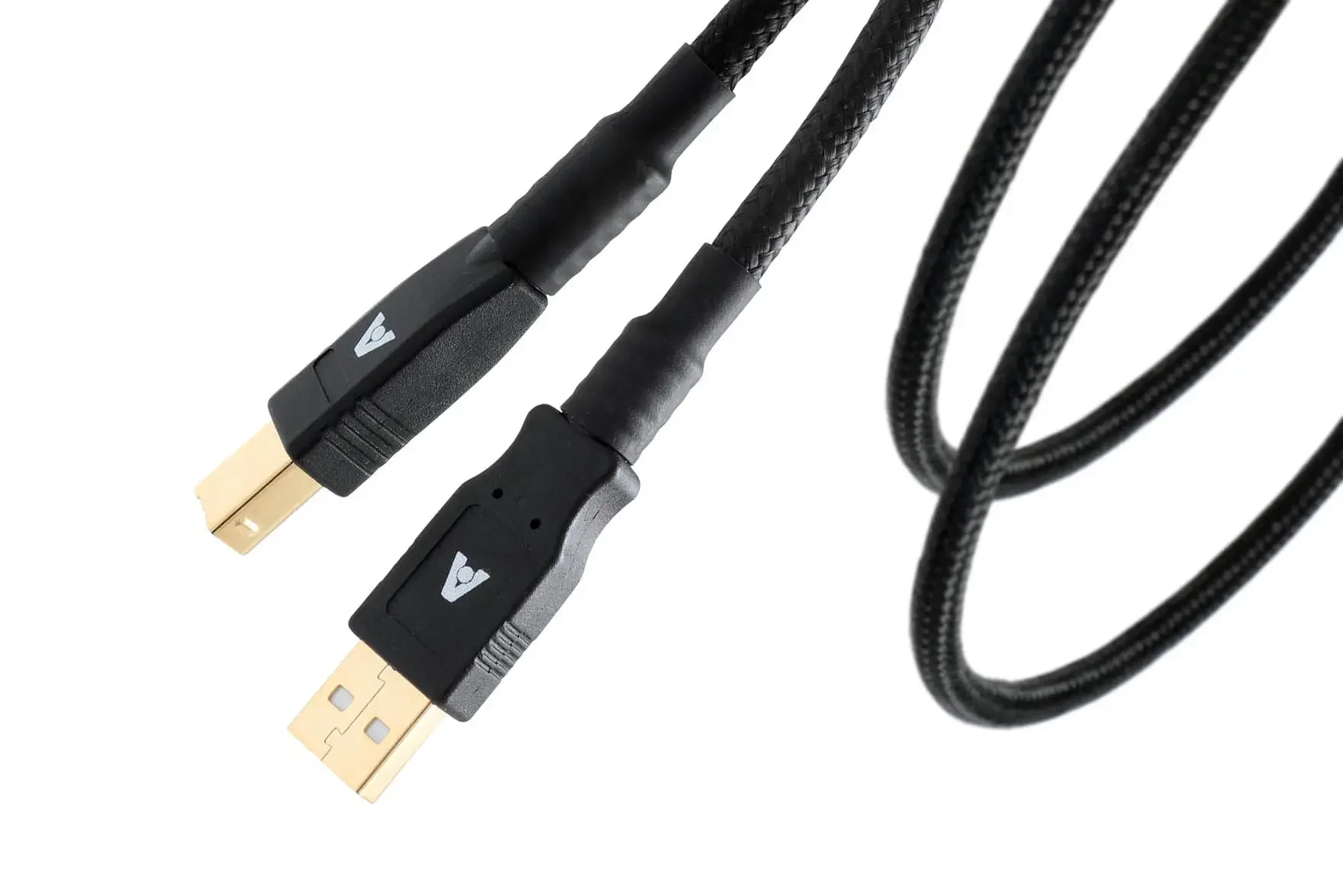
Featuring a solid core OCC copper conductor, the Hyper SC USB cable has been engineered to provide an extremely high level of performance from file-based (PC or streaming) audio sources. The Hyper has been created with a particular emphasis on minimising the effects of low-level RFI and EMI on digital audio signals, which can degrade perceived dynamic range and add a characteristic ‘digital glare’ to the sound of the system, which typically results in listener fatigue.
The traditional view of USB requires nothing more than the transfer of data from one device to another. While that’s essentially true for a printer or hard drive, it’s an overly simplistic view when considering USB connection for high quality audio, where RFI and EMI ‘noise’ is frequently a pervasive problem.
General purpose USB cables use a basic twisted pair construction for data transmission, theoretically this necessitates matched twist ratios for the data pair (to minimise the intra-pair skew). In practice, increased capacitance between the data pair and the power and ground conductors can increase crosstalk dramatically. Atlas use matched pairs of cables whose lengths have been critically controlled to maintain uniformity, while utilising a triple shielding technique that isolates the differential data, power/ground from each other as well as providing an integral shield around the entire cable to help reject jitter and external noise.
Featuring a solid core OCC copper conductor, the Hyper SC USB cable has been engineered to provide an extremely high level of performance from file-based (PC or streaming) audio sources. The Hyper has been created with a particular emphasis on minimising the effects of low-level RFI and EMI on digital audio signals, which can degrade perceived dynamic range and add a characteristic ‘digital glare’ to the sound of the system, which typically results in listener fatigue.
The traditional view of USB requires nothing more than the transfer of data from one device to another. While that’s essentially true for a printer or hard drive, it’s an overly simplistic view when considering USB connection for high quality audio, where RFI and EMI ‘noise’ is frequently a pervasive problem.
General purpose USB cables use a basic twisted pair construction for data transmission, theoretically this necessitates matched twist ratios for the data pair (to minimise the intra-pair skew). In practice, increased capacitance between the data pair and the power and ground conductors can increase crosstalk dramatically. Atlas use matched pairs of cables whose lengths have been critically controlled to maintain uniformity, while utilising a triple shielding technique that isolates the differential data, power/ground from each other as well as providing an integral shield around the entire cable to help reject jitter and external noise.